
The technology behind Living Liquid
Land got mortgages. Stocks got margin. Private equity got nothing — until now. How Techdollar turns frontier-tech equity into working capital, and why that flywheel changes finance.

Land got mortgages. Stocks got margin. Receivables got factoring. Private equity, the asset class where modern wealth is actually created, got nothing. Hundreds of billions of dollars in verified ownership sit motionless while the world competes for capital. This article examines how Techdollar unlocks that dormant value through verified private lending. Techdollar is software: a compliance-focused private lending platform, and company-embedded tooling for employee retention and upside ownership, purpose built to provide a liquid life to the people building frontier technology. Setting that platform in motion starts a flywheel that compounds far beyond its own loan book: capital optimized instead of stranded, more companies formed and funded, deeper and fairer markets, and measurably faster global progress.
The starting point: wealth that does not circulate
A structural shift has taken place in how wealth is created. Companies now remain private for a decade or longer, and the value appreciation that once occurred in public markets, where any shareholder could sell on an exchange, now accrues behind closed doors. The resulting wealth is real and well documented: it appears in secondary market prices, cap tables, and fund statements. Yet it does not function as wealth. It cannot be spent, pledged, or diversified. It can only be held.
The consequences propagate through the entire innovation-finance circuit. Institutional investors receive distributions at roughly 6% of net asset value per half-year, against a ten-year average near 14%; without cash returned, they cannot recommit to new funds. Venture portfolios carry record unrealized value that never converts to distributions. Employees forfeit earned equity every year because exercising options requires cash they cannot raise. And the least visible stall is the most consequential: angel and seed capital is disproportionately recycled entrepreneurial wealth, so when realization is deferred by a decade, the formation rate of new companies falls with it.
The existing remedies are inadequate by construction. Secondary sales transacted a record $226-233 billion in 2025, yet that record represents roughly 2% annual turnover of private-market assets, and venture positions cleared at approximately 75% of net asset value. A 25% discount is, in effect, the current market price of liquidity, and a sale surrenders all future upside besides. Company tender offers are episodic and discretionary. Specialty lenders serve only the ultra-high-net-worth tier. Banks decline the asset class entirely.
What is missing is the mechanism every other major asset class already possesses: a routine, standing credit market. Real estate supports mortgages; public portfolios support securities-based lending; receivables support factoring. Private equity, almost uniquely among large asset classes, supports no credit at all below the institutional tier. Techdollar exists to build exactly that market, starting where the secondary tape is deepest: frontier technology. AI, robotics, aerospace, defense, and compute. What follows is how it works, scenario by scenario.
Scenario 1. How the liquidity is enabled, and how it is locked
Every credit market begins with the same two questions: is the collateral real, and can the lender rely on it? The platform's origination process is designed to answer both to an institutional standard.
Enabling: verification and pricing.
A prospective borrower's position is verified through documentary proof of ownership: share certificates, cap-table records, and grant and purchase agreements, with ownership review conducted in partnership with established audit firms. Pricing comes from where the asset actually trades. Live secondary market data gives each approved company defined lending parameters: a reference price, a maximum loan-to-value ratio, an interest rate, and a risk tier. In public markets, the exchange tape performs this function; here, the secondary market tape performs it. Collateral is marked against live secondary market data, not stale funding rounds and not appraisals.
Locking: protected security and conservative structure.
Once terms are accepted, the collateral is locked through a formal pledge: a protected security interest over the shares, custody of the underlying documentation, and coordination with the issuing company's transfer provisions. The shares remain in the borrower's name and never move; transfer occurs only on a qualifying default. The facility is structured conservatively, with advance rates of 20% to 60% of verified collateral value, calibrated to the depth of the company's secondary market, and margin and resolution thresholds set well above the initial loan. The lock is deliberately symmetrical: the pledge encumbers the shares for the life of the facility, and the borrower's ownership, with all of its upside, is preserved for the life of the facility. Nothing is sold; nothing is diluted; no taxable disposition occurs at drawdown.
A worked example.
A worked example. frontier technology company with an actively traded secondary market. A $10 million facility is structured at a 50% loan-to-value ratio for a twelve-month term. Interest is serviced monthly; principal is repaid at maturity, at which point the pledge is released and the shares return to the founder's unencumbered ownership. The founder has accessed eight figures of capital while remaining exactly what the company needs them to be: a fully committed shareholder.
Scenario 2. How the liquidity is delivered
Traditional private-stock lending is bespoke: months of negotiation, one-off documentation, and pricing that reflects the transaction costs more than the credit risk. Techdollar replaces that with software: standardized documentation, a repeatable private lending process, and compliance built into the workflow rather than bolted on after it.
The sequence.
Application and verification lead to a defined offer, with amount, rate, term, and fee schedule stated up front. Upon acceptance, the protected security interest is registered and the pledge documentation confirmed. Funds are then disbursed directly to the borrower's bank account. The timeline is measured in days from approval, not months; the documentation is standardized across the book, which is precisely what allows facilities of $400,000 to be economical alongside facilities of $40 million.
Servicing.
Repayment follows a clean, predictable structure: interest serviced monthly, principal as a single payment at maturity, and no prepayment penalty. Borrowers whose liquidity arrives ahead of schedule simply repay early and reduce their total interest cost. Every payment, balance, and date is visible to the borrower throughout the term.
A worked example.
An engineer leaves a late-stage company with 90 days to exercise vested options: a $600,000 outlay including tax, against equity with an observable secondary market value of $2.4 million. Under the status quo, that equity is forfeited. Through the platform, the position supports a facility sized to the exercise cost, delivered inside the deadline. The engineer keeps what they earned; the eventual upside remains theirs; the facility is repaid at maturity, with a future liquidity event serving as one early repayment path.
Scenario 3. How people and funds reuse the capital
Unlocked capital does not sit still, and the reuse patterns are where the model's economic weight accumulates.
Individuals.
The rational first move for anyone concentrated in a single private position is diversification: into public portfolios, fixed income, and property. Beyond rebalancing, borrowers exercise expiring options, meet life obligations without distressed sales, and, critically, write the angel and pre-seed checks that recycled entrepreneurial wealth has always funded. Every billion dollars of unlocked liquidity represents funding capacity for roughly 320 seed-stage companies at the current US median round of $3.1 million.
Funds and family offices.
Institutional holders reuse the mechanism differently. A fund carrying mature, unrealized positions can borrow against them to bridge distributions to its own investors, addressing the distribution drought directly, or to finance follow-on investments without untimely dispositions. Family offices rebalance concentrated legacy positions without surrendering them. General partners can extend the program to their portfolio companies' employees as a retention benefit.
The common thread: capital that was structurally frozen re-enters circulation at every level of the market simultaneously, across households and funds alike, without a single share changing hands.
Scenario 4. The additional opportunities it creates
A standing credit market against private equity generates opportunities well beyond its own loan book.
Structured private-market access for specialized funds.
Secondaries firms, crossover investors, and opportunistic credit desks can participate as standing liquidity providers for privately negotiated transactions in collateral positions. For these funds, the platform offers what the private market has never provided at scale: recurring, structured access to sought-after private-equity positions at defined entry points, access historically gated by relationships and episodic deal flow. Their committed participation, in turn, deepens the liquidity behind every position in the book. A back-office function becomes a two-sided institutional marketplace in its own right.
A private-market data layer.
A private-market data layer. had in continuous form: how much credit a private company's shares support, at what rate, and at what advance ratio. It is a credit-based read on private valuations between funding rounds. Over time this data asset serves analysts, allocators, and the companies themselves, and it feeds directly back into sharper underwriting.
Distribution through established channels.
Wealth managers, private banks, and brokerages can offer equity-backed facilities to their clients through the platform's underwriting and servicing infrastructure, extending their product shelf without building the capability internally, and extending the platform's reach without building distribution.
A stronger equity currency for companies.
Employers benefit directly: equity compensation regains recruiting and retention power when employees can see that it is financeable. Techdollar embeds into the company's equity stack as standing tooling, a benefit offered alongside the grant itself, so employees stay, keep their upside ownership, and never face a forced sale. Fewer distressed side-sales mean cleaner cap tables and fewer unknown holders. Companies gain a liquidity answer for their people that does not require running a tender or accelerating a listing.
A template for every verified asset.
Prove the machinery on private equity and it generalizes: fund interests awaiting distributions, revenue royalties, and other verified but illiquid claims can be underwritten by the same process and funded by the same investor base, with each new collateral class feeding the same market.
Scenario 5. How the system bootstraps the market
New markets are not declared into existence; they are bootstrapped through a sequence in which each participant's entry improves the terms for the next. The mechanism here follows a well-worn historical path. Standardization is what turned housing credit from bespoke bank lending into the deepest credit market in the world, and it compounds through a defined loop:
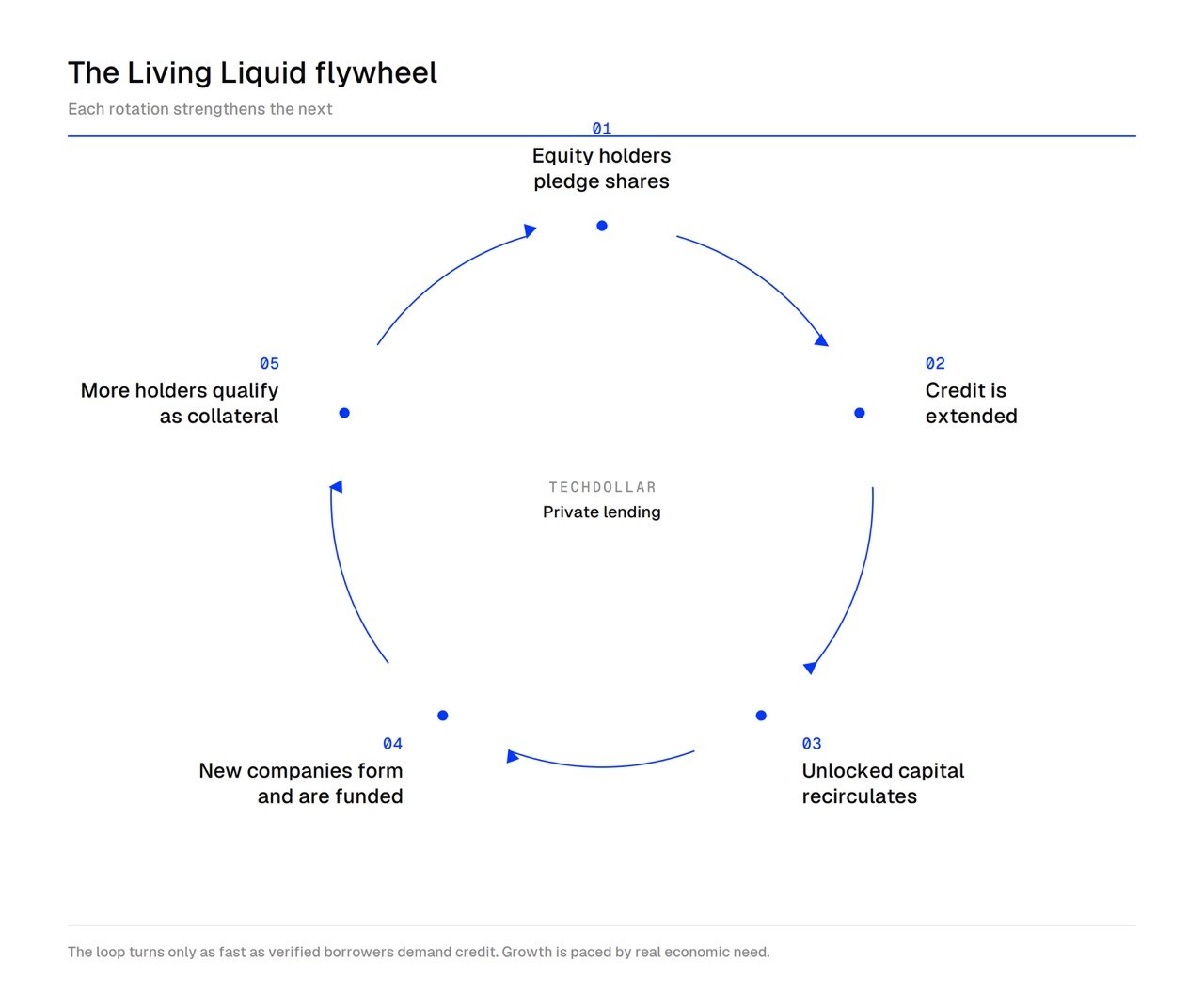
Each rotation strengthens the next in three distinct ways:
* Supply-side network effects. Each company onboarded as approved
collateral unlocks its entire population of holders at once,
founders, employees, and early investors alike, at near-zero
marginal underwriting cost.
* Data compounding. Each facility generates repayment and valuation
data; better data sharpens underwriting; sharper underwriting
supports tighter pricing and higher confidence; better terms
attract more borrowers.
* Collateral regeneration. The unlocked capital itself recirculates
into new company formation, and those companies become the
approved collateral of the following cycle. The market literally
grows its own future supply.
The loop carries a natural governor: it turns only as fast as verified borrowers demand credit. Growth is therefore paced by real economic need, which is precisely what permits compounding rather than overheating. Even modest penetration produces a substantial market: applying the platform's standard parameters to the estimated $650-700 billion of insider-held US unicorn equity, a 2% adoption rate yields a loan book near $7 billion; 5% adoption yields a book of some $17 billion, a lending channel equal to roughly 7% of 2025's record secondary volume, delivered without a single share changing hands and without a point of NAV discount.
Scenario 6. Why the system serves the general economy
The macroeconomic case deserves to be stated directly, because it is larger than any individual participant's gain.
It raises the velocity of productive capital.
Wealth locked in private equity has a velocity of zero: it funds nothing, collateralizes nothing, and circulates nowhere. A standing credit market restores motion. The shares stay put; their purchasing power enters circulation. It is a liquidity injection into adjacent markets achieved without a sale and without new money creation. Existing wealth is simply restored to productive use.
It accelerates company formation.
Because entrepreneurial ecosystems are recursive, with this generation's founders and employees funding the next generation's ventures, the recycling rate of realized wealth is a direct input to the rate of company creation. Deferring realization by a decade throttled that input. Collateralized credit restores it while preserving alignment: a founder who borrows rather than sells remains fully committed to the company and simultaneously becomes a source of new investment. More companies are formed; more companies can raise; more opportunities arise. The compounding of those effects is measurably faster technological and economic progress.
It improves allocation across the system.
Capital held involuntarily in a single concentrated position is, by definition, misallocated relative to its holder's preferences. Releasing it lets households diversify, funds distribute, and institutions recommit, moving the entire system toward more efficient allocation. Public markets, fixed income, and property all receive flows that concentration had suppressed.
It strengthens the labor market for talent.
When equity compensation is financeable, it is credible. Talent can move to the highest-value opportunity without forfeiting earned wealth, and early-stage companies, which pay disproportionately in equity, compete for that talent on fairer terms.
It deepens financial-market infrastructure.
The system adds a continuous valuation signal for one of the economy's most opaque sectors, and an institutional private marketplace where episodic, relationship-gated dealing used to be. Each is a durable piece of market infrastructure that outlives any individual transaction.
The pattern has precedent. Every time finance has extended routine credit to a previously unbankable asset, whether land, housing, receivables, or public securities, the result has been the same: dormant value mobilized, markets deepened, and growth compounded. Private equity is simply the largest asset class still waiting for its turn.
Conclusion: an asset working at half capacity
The proposition, stripped to its essentials, is straightforward. A collateral base of several hundred billion dollars in insider-held private equity currently supports almost no credit. The one existing liquidity channel reaches about 2% of the market per year and charges a 25% discount for the privilege. Meanwhile, the deficit propagates backward through the entire innovation-finance circuit, from institutional recommitments to seed-stage company formation.
Techdollar's answer is deliberately conservative in structure: verified collateral, protected security interests, conservative advance rates, standardized private execution, and disclosed economics. It is delivered as software, a compliance-focused private lending platform, purpose built to give the holders of frontier technology equity a liquid life. Even minimal adoption produces a multi-billion-dollar loan book and recirculated capital equivalent to thousands of seed-stage financings, while every borrower keeps every share they pledged.
An asset that cannot be borrowed against is an asset working at half capacity. The question for traditional finance is whether the collateral is sound and the inefficiency is large enough to matter. The data suggest it is measured in the tens of billions: accessible, underwritable, and currently priced at zero.
The rest is underwriting.
-----------------------------------------------------------------------------
This article is for informational purposes only and does not constitute
financial, investment, legal, or tax advice. Lending and borrowing involve
risk. Scenario figures are illustrative estimates based on stated
assumptions, not projections. Feature availability depends on jurisdiction
and identity verification.
Sources
WIPO, Global Unicorn Valuation 2025
https://www.wipo.int/en/web/global-innovation-index/w/blogs/2026/global-unicorn-valuation-2025
Founders Forum, Unicorn Companies 2025
https://ff.co/unicorn-companies-2025/
PitchBook, Top 10 startups control record 51.8% of unicorn value
https://pitchbook.com/news/articles/top-10-startups-now-control-record-51-8-of-total-unicorn-value
Pensions & Investments, Secondaries volume hits record $226B in 2025
UBS, Record secondary market volume, H1 2025
Jefferies, Global Secondary Market Review, July 2025
Chronograph, Discounts and Premiums in Venture Secondaries
https://www.chronograph.pe/examining-the-role-of-discounts-and-premiums-in-venture-secondaries/
Carta, VC Fund Performance, Q2 2025
https://carta.com/data/vc-fund-performance-q2-2025/
Equitybee, DPI Performance Report, Q1 2025
https://equitybee.com/dpi-performance-report/q1-2025
Crunchbase, Seed funding trends 2025
https://news.crunchbase.com/venture/average-seed-funding-amounts-deals-grew-2025/
AIMA, Private credit market growth
-----------------------------------------------------------------------------